EuroTube Looks to the Future Through a Concrete Scope
EuroTube Looks to the Future Through a Concrete Scope
The research organization is building airtight concrete tubes for tomorrow’s high-speed travel.
Imagine sitting in a comfortable capsule, gliding from Zurich to Bern in just ten minutes. Of course, travel through a vacuum tube still belongs to the realm of the future. But some clever minds are already dedicating themselves to it. More than a few are based here at the Switzerland Innovation Park Zurich (SIPZ).
Swissloop, for example - ETH Zurich’s student focus team - is already sending small capsules through Hyperloop systems at speeds of up to 300 kilometers per hour. And then EuroTube, a nonprofit research organization dedicated to developing the infrastructure. “Hyperloop has been a widely discussed idea for years now, as a fast and sustainable form of mobility,” says Steffen Hartmann, Head of Communications at EuroTube.
His email signature reads: “Connecting cities at high speed in a sustainable way.” And just as quickly, he heads to the whiteboard in the co-working space of the SIPZ pavilion, sketching out why, from an energy perspective, vacuum tunnels make perfect sense. Except nearly no one is dedicating any thought to the materials or the infrastructure themselves, he adds, after erasing both rolling and air resistance from the board. “This is where we see potential: working with concrete and with decentralized components. Resorting instead to regional materials and local specialists. This way, transport over hundreds or even thousands of kilometers becomes unnecessary.”
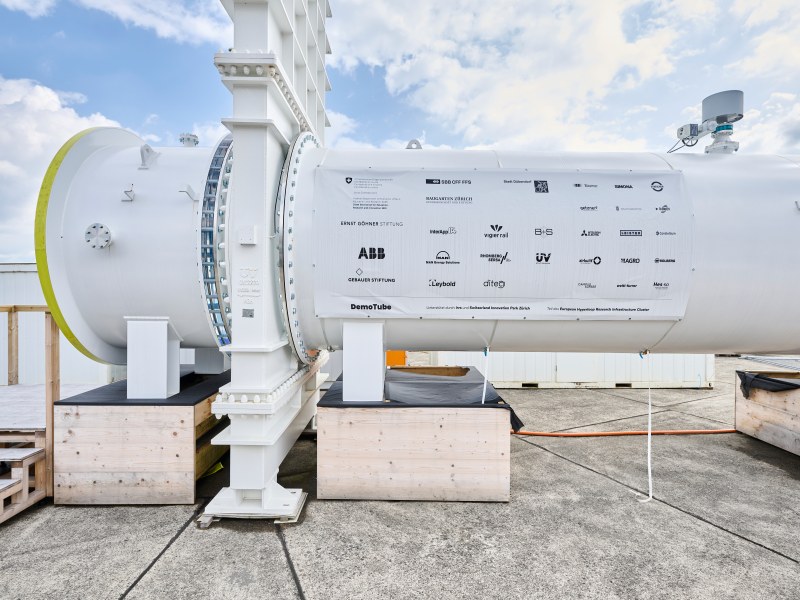
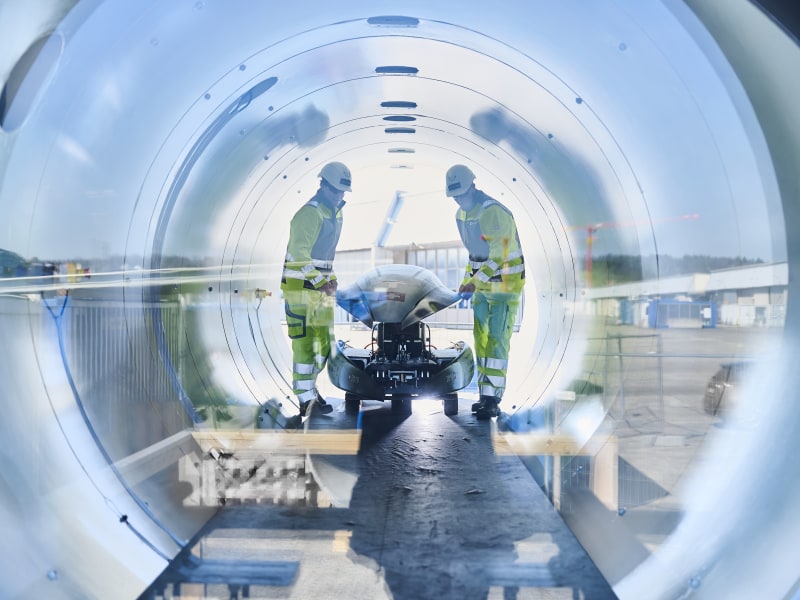
In the coming months, EuroTube will independently construct a roughly 120-meter-long test tube in Dübendorf. With few off-the-shelf options available, their team creates many of the components on their own. The process from design to prototype is expected to yield valuable insights. The construction itself is already a test, with more to come: safety systems, vacuum compatibility, entry through an airlock, low-speed runs under vacuum. The so-called DemoTube will be made available to research groups and universities as an open-source project.
Safety becomes a major factor when high speeds come into play. As do politics. “If key decision-makers recognize the opportunity, things could suddenly move fast,” says Hartmann during a walk around the DemoTube, which currently measures just under eight meters. Progress is speeding up elsewhere: in China, full-scale Hyperloop test tracks are already being built; a route from Shanghai to Hangzhou is planned for completion by 2035. And in Italy, a major freight project is underway between Padua and Venice. “Hyperloop’s success depends on how quickly we can move from simple test tracks to full-scale infrastructure,” says Hartmann. Switzerland Innovation Park Zurich is expected to play a key supporting role.